

Welcome, Minecraft players! Are you looking to master the art of mushroom farming? Whether you need an infinite supply of Mushroom Stew or want to build with the unique mushroom blocks, you’ve come to the right place. In this comprehensive guide, we’ll cover everything you need to know about mushrooms in Minecraft 1.21, from finding them in the wild to building fully automatic farms. Let’s dig in!

Table of contents
Where to Find Mushrooms? The Best Biomes and Locations
Finding mushrooms is the first step, and knowing where to look is fundamental to starting your journey in mushroom farming in Minecraft. They only grow in specific conditions, primarily in areas with a light level of 12 or less. However, some biomes are far better for mushroom hunting than others.
The best biomes for finding mushrooms are:
Follow us on social media and stay one step ahead of the game! 🚀






- Swamp: The dark, damp environment under the large oak trees is a perfect breeding ground for both red and brown mushrooms.
- Old Growth Taiga (Spruce and Pine): The massive trees in these biomes create extensive canopies, providing the low light levels mushrooms need to thrive. You’ll often find them scattered across the Podzol floor.
- Mushroom Fields: This is the jackpot! This rare biome is covered in Mycelium, giant mushrooms, and Mooshrooms. Mushrooms can grow here at any light level, making it the safest and most abundant source.
- The Nether (Any Biome): The Nether is a fantastic place to find both red and brown mushrooms, as well as the unique Crimson and Warped Fungi. The inherent darkness of this dimension means they can spawn almost anywhere.
- Caves: Traditionally, caves were a great source. However, with the updated cave generation in recent versions, the new, larger caves are often too open and bright. You’ll have more luck in older, tighter cave systems or unlit corners of the new ones.

Here is a helpful visual summary of the best biomes to search:
Unique and Unusual Ways to Get Mushrooms
Beyond biome hunting, there are several other clever ways to obtain mushrooms:

- Mooshrooms & The Bogged: You can get 5 red mushrooms by shearing a Mooshroom. Similarly, the new Bogged mob, found in Swamps and Trial Chambers, can be sheared for 2 mushrooms (either red or brown). This is a renewable source if you build a farm for them.
- Witch Huts: You can always find a potted red mushroom inside a Witch Hut.
- Fallen Logs: In Old Growth Taiga biomes, you might find mushrooms growing on top of fallen logs.
- Trial Chambers: Look for mushrooms in decorative pots within Trial Chambers.
Giant Mushrooms and Their Blocks
You’ve probably seen those colossal mushrooms in Mushroom Fields or Dark Oak Forests. You can grow your own! Simply place a red or brown mushroom on a suitable block (like Dirt, Grass, Podzol, or Mycelium) and use Bone Meal on it. It requires a large, dark space to grow. Growing giant mushrooms this way isn’t just for looks; it’s a key part of mushroom farming in Minecraft if you want to harvest a large number of blocks quickly.
To harvest the blocks, you’ll need a tool with the Silk Touch enchantment. Without it, the blocks will drop regular mushrooms. The mushroom blocks have a unique, fleshy texture on the inside but look like the cap on the outside, making them interesting for building.

Instantly Top Up Minecraft Minecoin on Item4Gamer. Fast, secure, and back in the game in seconds!
Nether Fungi: Crimson and Warped
The Nether introduced two new types of fungi: Crimson and Warped. These are essential for navigating and surviving in the dimension.
- Location: Crimson Fungi are found in the Crimson Forest biome, while Warped Fungi are found in the Warped Forest.
- Growth: You can grow them into huge “trees” using Bone Meal, but only when planted on their corresponding Nylium block (Crimson Nylium or Warped Nylium).
- Stem Blocks (Hyphae): The “trunks” of these giant fungi are called Hyphae. They are a type of wood, meaning they don’t burn and can be crafted into planks, stairs, and slabs. They are also easily broken with an axe.
- Shroomlights: These blocks grow within the caps of giant fungi and are a beautiful, organic light source that emits a light level of 15.
How to Build a Mushroom Farm (Semi-Automatic & Automatic)
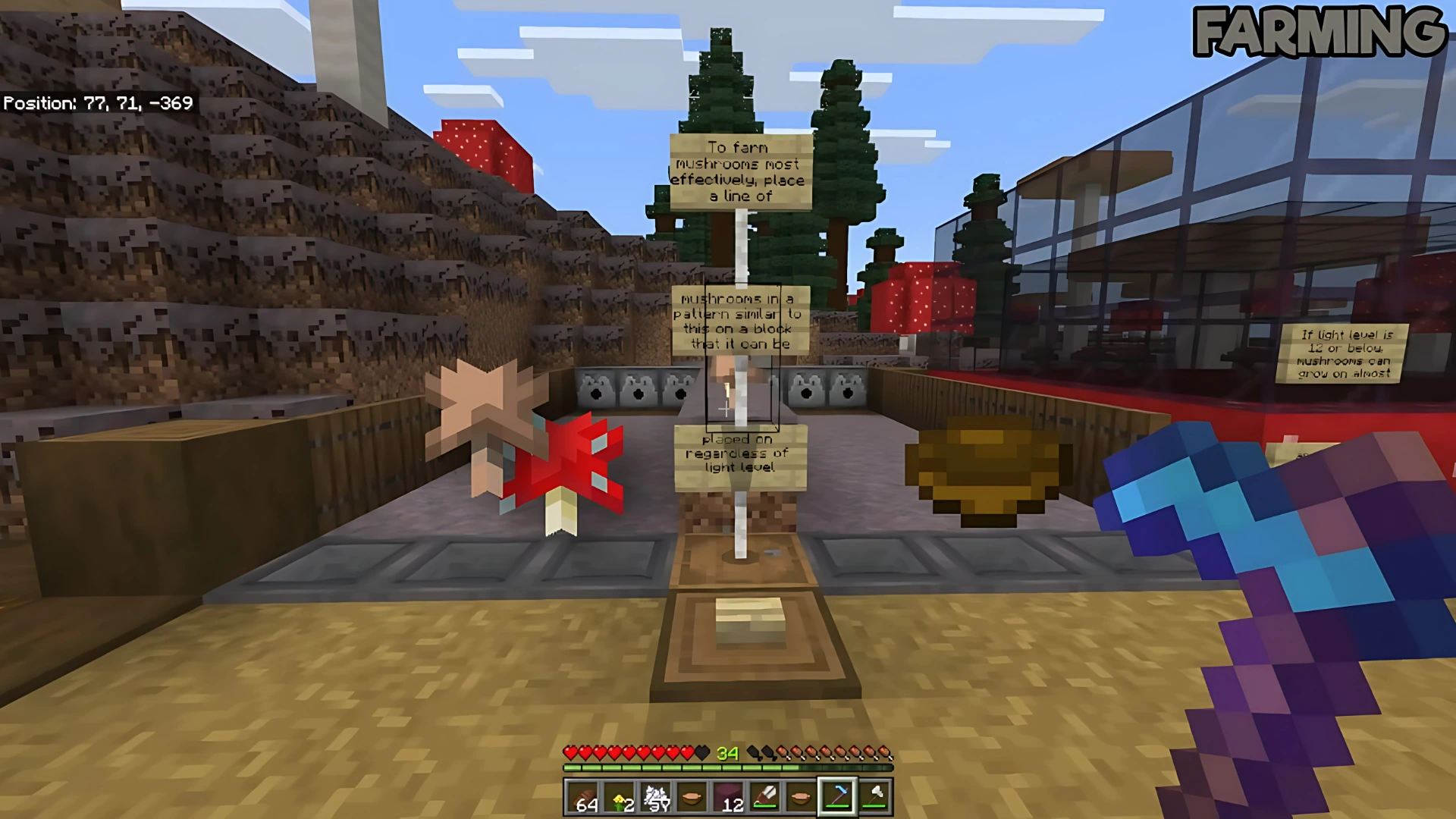
Ready to get an infinite supply? Let’s build a farm. The core mechanic is simple: mushrooms spread to adjacent blocks if the conditions are right.
Key Farming Mechanics:
- Block Type: Mushrooms can be planted and will spread on blocks like Dirt, Grass, Stone, and more, as long as the light level is low. However, they spread fastest and most efficiently on Mycelium and Podzol.
- Light Level: The light level must be 12 or below. Complete darkness is ideal.
- Space: There needs to be empty space for the mushrooms to spread into.
Simple Semi-Automatic Farm Design:
- Create a large, dark, enclosed room (e.g., 9×9).
- Place a block of Mycelium or Podzol in the center.
- Plant a mushroom on the central block.
- Wait. The mushroom will slowly spread to the surrounding dirt blocks.
- Harvest them manually and repeat.
Fully Automatic Farm Design:
For a more advanced farm, you can use water and dispensers.
- Create a platform of Mycelium or Podzol with mushrooms planted on it.
- Set up a dispenser with a water bucket connected to a timer (Redstone clock).
- The timer will periodically release water, which flows across the platform, breaking the newly grown mushrooms.
- The water pushes the mushroom items into a hopper, which collects them in a chest.
This setup provides a steady, hands-free supply of mushrooms.
Mushroom Stew and Suspicious Stew
So, what do you do with all these mushrooms? Make stew!
- Mushroom Stew: Crafted with one Red Mushroom, one Brown Mushroom, and a Bowl. It’s an excellent early-game food source, restoring 6 hunger points. It’s especially useful in the Nether, where other food sources can be scarce.
- Suspicious Stew: This is a special stew with a secret. It’s crafted with one Red Mushroom, one Brown Mushroom, a Bowl, and any flower. The type of flower you add determines the status effect you get when you eat it. For example, an Oxeye Daisy gives you Regeneration. It’s a powerful tool, especially in modes like UHC (Ultra Hardcore).
Also read: Beyond the Blocks: Have You Found These Minecraft Secret Rooms?
Conclusion
You are now equipped with all the knowledge needed to become a master of mushroom farming in Minecraft 1.21. We’ve covered the best places to find them, from the dark floors of an Old Growth Taiga to the alien landscapes of the Nether. You know how to cultivate them, build automated farms, and utilize every part of the fungus, including the valuable Nether Hyphae and Shroomlights. Go forth, build your farm, and may your chests overflow with fungi!
Frequently Asked Questions (FAQ)
A1: The most common reasons are light levels being too high (must be 12 or less) or not enough space. Ensure your farm is completely dark and there are empty adjacent blocks for the mushrooms to grow onto.
A2: No, Bone Meal only works to grow a small mushroom into a giant one. It does not speed up the natural spreading process for farming small mushrooms.
A3: The absolute fastest way is to find a Mushroom Fields biome. If that’s not an option, building a large, multi-layered automatic farm using Mycelium or Podzol is your best bet for a high-yield, long-term supply.
A4: Yes, using a Hoe is the fastest way to break mushroom blocks. However, you will need a Silk Touch enchantment on your tool if you want to collect the block itself.